
How Dave’s Hot Chicken Uses AI to Win the Chicken Wars

Chicken quick-service sales surged nearly 10% in 2024 as the category heats up against giants like Chick-fil-A and Popeyes. Dave’s Hot Chicken has placed broad bets on artificial intelligence across drive-thru, mobile ordering, robotic fry stations, and delivery to catch this wave. But their AI approach isn’t about eliminating human labor—it’s about augmenting it to unlock new operational levers. "AI enables workers to do more, not replace them," says CTO Leon Davoyan.
Augmentation, Not Automation: Why Replacing Workers Is the Wrong Constraint
Conventional wisdom sees AI in restaurants as a cost-cutting tool to replace frontline workers. That’s why previous AI drive-thru attempts by McDonald’s and Taco Bell faced failure—they aimed to remove humans, ignoring retention and experience. Dave’s Hot Chicken challenges this by designing systems where AI serves as an assistant, not a replacement, enhancing human work rather than displacing it.
This represents a key constraint repositioning: labor is not replaced but leveraged for higher throughput and better customer service. It changes the ROI calculus on AI investments, allowing scale without headcount cuts. This is a practical leverage lesson detailed in our analysis of why AI actually forces workers to evolve, not replace them.
Concrete AI Levers Driving Order Volume and Accuracy
Dave’s Hot Chicken deploys AI-enabled order readiness predictions shown on digital boards in stores, improving accuracy by aiming for a two-minute window. This has increased weekly transactions by seven to eight compared to non-AI locations. The mechanism here is better prediction reducing customer wait uncertainty, which converts more orders into sales.
Additional AI applications include robotic arms at fry stations that autonomously predict and maintain fry production flow, aiming to sustain food quality while reducing waste. Although robots are expensive—creating barriers to entry—these applications reach ROI thresholds that justify scaling.
Unlike many chains still reliant on cloud-only POS systems, Dave’s Hot Chicken uses a local edge computing device from Qu, safeguarding operations during the recent Amazon Web Services outages. This system eliminated downtime risks, preserving slim restaurant margins. It’s an infrastructure-level lever for operational resilience, a critical factor rarely prioritized.
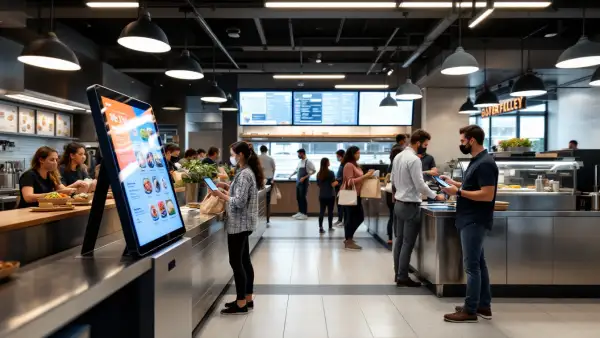
The chain’s 23% kiosk penetration in-store raises average check size by 5.9%, delivering ROI under a year. The kiosk design purposely keeps humans engaged, allowing cashiers to monitor and step in, preserving hospitality quality. This hybrid human-machine interface reveals leverage beyond pure automation.
Why This Matters for Operators and Investors
The constraint Dave’s Hot Chicken has unlocked is not low labor cost but reliable, accurate, and scalable food preparation combined with enhanced customer experience. This shifts the competitive battle from traditional efficiency wars to systems that boost check size, throughput, and operational uptime simultaneously.
Investors should note how private equity firm Roark Capital’s $1 billion acquisition aligns with this system-driven growth strategy. Fast-casual food brands adopting AI without headcount cuts create durable moats by mastering these layered leverage points.
Operators should study how blending AI with human supervision outperforms pure automation. This moves AI beyond buzz, into integrated systems that generate compounding advantages daily, not just tech experiments.
"Leverage comes from combining AI with the irreplaceable human touch—everything else fails the ROI test."
For deeper context on operational constraints and AI-driven human augmentation, see our analysis on process documentation best practices and AI’s role in evolving workforce leverage.
Related Tools & Resources
For businesses looking to enhance their operational efficiency through AI, tools like Blackbox AI can facilitate the integration of smart coding solutions that align with the innovative approaches seen in Dave’s Hot Chicken. By leveraging AI to streamline and augment existing processes, companies can focus on improving customer experiences and operational resilience, much like the strategies discussed in this article. Learn more about Blackbox AI →
Full Transparency: Some links in this article are affiliate partnerships. If you find value in the tools we recommend and decide to try them, we may earn a commission at no extra cost to you. We only recommend tools that align with the strategic thinking we share here. Think of it as supporting independent business analysis while discovering leverage in your own operations.
Frequently Asked Questions
How does Dave’s Hot Chicken use AI to improve its operations?
Dave's Hot Chicken uses AI in drive-thru, mobile ordering, robotic fry stations, and delivery to augment workers, improve order accuracy, and increase throughput without reducing headcount.
What impact has AI had on Dave’s Hot Chicken’s order volume?
The deployment of AI-enabled order readiness predictions has increased weekly transactions by 7 to 8 compared to locations without AI, by reducing customer wait time uncertainty.
How does the robotic fry station system work and what benefits does it bring?
Robotic arms autonomously predict and maintain fry production flow, sustaining food quality while reducing waste. Although costly, these systems reach ROI thresholds that justify scaling.
Why is edge computing important for Dave’s Hot Chicken?
Dave's Hot Chicken uses a local edge computing device from Qu to safeguard against cloud outages, such as those by Amazon Web Services, eliminating downtime risks and protecting slim restaurant margins.
What effect do kiosks have on Dave’s Hot Chicken’s sales?
With 23% kiosk penetration in-store, the average check size increases by 5.9%. The kiosks are designed for hybrid human-machine interaction, preserving hospitality quality.
How does Dave’s Hot Chicken’s AI strategy differ from other fast food chains?
Unlike chains aiming to replace workers with AI, Dave’s Hot Chicken uses AI to augment human labor without headcount cuts, enhancing customer experience and operational leverage.
What role does human supervision play in Dave’s Hot Chicken’s AI systems?
Human workers remain engaged to monitor and intervene when necessary, as Dave’s Hot Chicken believes the combination of AI with human touch creates better ROI and customer service.
Why should investors be interested in Dave’s Hot Chicken’s AI approach?
Investors like Roark Capital recognize that AI-driven systems expanding throughput and check size without labor cuts create durable competitive advantages and align with long-term growth strategies.