
How EU Talks on Russian Frozen Assets Shift Fiscal Power Dynamics

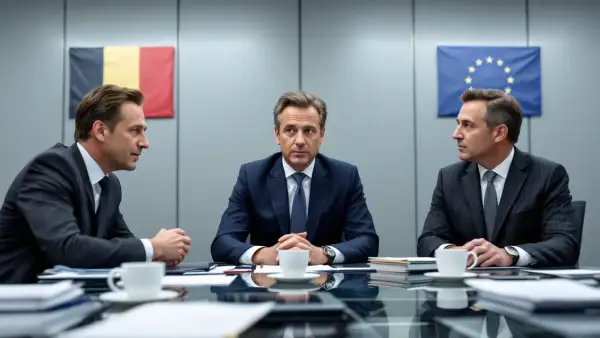
European Union leaders face a complex puzzle: billions in Russian frozen assets locked amid geopolitical tensions. In December 2025, EU Commission President Ursula von der Leyen and Germany’s Finance Minister Christian Lindner held 'constructive' talks with Belgian Prime Minister Alexander De Croo to chart a path forward. This cooperation signals more than diplomacy; it reveals a strategic realignment of financial control and multilateral leverage.
Frozen assets aren’t mere political tokens—they represent a substantial leverage point over fiscal policy and sanctions enforcement. EU states managing these holdings wield power far beyond traditional budget lines. Unlocking or redirecting frozen funds could recalibrate war-era economics without direct taxation or debt issuance.
This isn’t a dispute over custody but a race to redesign sovereign leverage frameworks. European financial governance is evolving to incorporate seized foreign reserves as tools for strategic advantage, not just punitive measures.
“Control of dormant assets is control of future policy agility,” captures the stakes for policymakers worldwide.
Conventional Wisdom Underestimates Fiscal Leverage in Frozen Assets
Market narratives frame frozen asset talks as political standoffs delaying post-war reconstruction funds.
They overlook that the real battle is over who designs and operates new financial conduits leveraging these funds to fuel reconstructed economies.
Unlike conventional debt or budget reallocations, frozen assets sit outside usual sovereign constraints, creating alternative fiscal space. This shifts the frame beyond mere sanctions enforcement to constraint repositioning—a theme explored in structural leverage failures elsewhere.
How the EU’s Multinational Approach Advances Leverage Beyond Borders
The EU’s collective stewardship of Russian frozen assets contrasts sharply with unilateral asset freezes pursued by countries like the U.S. or UK.
By pooling control under a supranational system, the EU unlocks compounding benefits from coordinated asset management, sidestepping fragmentation risks that dilute sanction impact.
Other nations missed this opportunity, handling frozen resources as isolated reserves, limiting their fiscal footprint. The EU’s system creates a platform lever enabling automatic reinvestment in reconstruction or sanctions compliance programs.
This mechanism resembles how OpenAI scaled ChatGPT’s user base through systemic leverage rather than one-off campaigns (read more).
Asset Control as a New Sovereign Constraint With Compounding Impact
Freezing foreign assets shifts from temporary coercion to a long-term financial tool. Managing these funds as operational capital enables the EU to side-step debt ceilings and tax hikes during critical funding phases.
This strategic move alleviates dependence on public debt issuance and conventional budget reallocations, unlocking fresh policy freedom uniquely embedded in asset custody models.
Similar leverage repositions appear in other industries, such as labor and market constraints discussed in labor shift analyses.
Who Benefits, Who Should Watch—and What Comes Next
EU policymakers act to institutionalize frozen asset management as a permanent fixture in financial sovereignty, not an ad hoc fix.
This development demands attention from national treasuries, international lenders, and multinational investors, all stakeholders in a rapidly evolving fiscal landscape.
Other regions, particularly those with large frozen external reserves, can replicate this model to build non-debt financial leverage that sustains economic initiatives without raising taxes or issuing bonds.
“Fiscal power increasingly hinges on the ownership and activation of dormant financial resources.”
Related Tools & Resources
As the EU navigates complex fiscal challenges, tools like Brevo can streamline communication and enhance marketing efforts for businesses looking to adapt to shifting economic conditions. With its powerful email marketing and automation capabilities, Brevo helps organizations leverage their assets to maintain engagement and drive growth even in uncertain times. Learn more about Brevo →
Full Transparency: Some links in this article are affiliate partnerships. If you find value in the tools we recommend and decide to try them, we may earn a commission at no extra cost to you. We only recommend tools that align with the strategic thinking we share here. Think of it as supporting independent business analysis while discovering leverage in your own operations.
Frequently Asked Questions
What are Russian frozen assets and why are they significant to the EU?
Russian frozen assets refer to billions of euros in financial resources seized or immobilized amid geopolitical tensions. They are significant to the EU as they provide a powerful fiscal leverage point beyond traditional budget lines, enabling alternative funding mechanisms for reconstruction and sanctions enforcement.
How do EU leaders plan to use the frozen assets?
EU leaders plan to manage the frozen assets collectively as operational capital, allowing them to sidestep debt ceilings and avoid tax hikes during funding efforts. This strategic approach aims to institutionalize frozen asset management for long-term financial sovereignty and economic leverage.
Who are the key figures involved in the EU talks on frozen assets?
Notable leaders involved include EU Commission President Ursula von der Leyen, Germany's Finance Minister Christian Lindner, and Belgian Prime Minister Alexander De Croo. They held constructive talks in December 2025 to coordinate approaches for these assets' management.
How does the EU's multinational approach differ from other countries?
The EU's collective stewardship pools control of frozen Russian assets under a supranational system, contrasting with unilateral asset freezes by countries like the U.S. or UK. This pooling unlocks coordinated asset management benefits, reducing fragmentation and boosting fiscal impact.
What fiscal advantages arise from controlling frozen assets?
Controlling frozen assets allows the EU to create alternative fiscal space, bypassing traditional sovereign constraints like debt issuance or taxation. This enables greater policy flexibility and sustainable funding for post-conflict reconstruction or sanctions compliance programs.
How could other regions replicate the EU's model?
Regions with large frozen external reserves can replicate the EU model to build non-debt financial leverage. By institutionalizing asset management, they can fund economic initiatives without raising taxes or issuing bonds, similarly gaining policy freedom.
What risks does the EU avoid by leveraging frozen assets?
The EU avoids risks associated with public debt issuance and conventional budget reallocations. By using frozen assets as operational capital, the EU reduces dependence on tax hikes and debt ceilings, providing a long-term financial tool.
Why is control over dormant assets described as control of future policy agility?
Dormant assets represent untapped financial resources that, when activated, provide expanded fiscal capacity beyond traditional constraints. Control over these assets translates to greater agility in policy decisions and sovereign financial management.