
How Southwest Airlines Navigates Shutdown Impact on Bookings

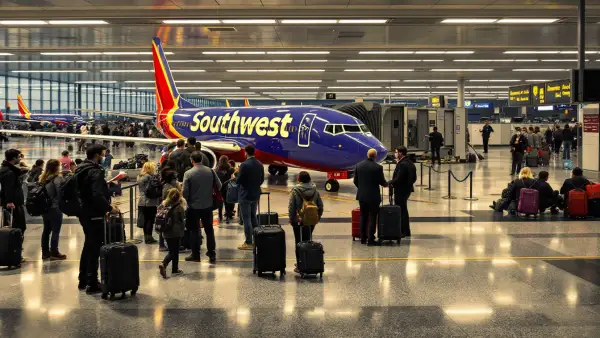
Government shutdowns in the U.S. historically drop travel demand by up to 15%. Southwest Airlines just lowered its full-year EBIT forecast due to a recent shutdown hitting bookings hard this December 2025.
But this is not simply a revenue drop story—it's about how Southwest's system design and booking leverage absorb shocks differently than legacy carriers.
This reveals a shift from volume dependence to constraint management in airline operations.
EBIT volatility exposes the fragile points behind large-scale service systems.
Booking Slowdowns Are Not Just Demand Issues
Conventional wisdom treats government shutdown travel dips as temporary demand shocks, expecting rapid rebounds. Analysts see this as a typical cyclical risk and cost-cutting trigger.
They're missing: it's a constraint repositioning challenge. Profit lock-in constraints apply as intangible assets like customer trust and scheduling reliability degrade.
Unlike traditional plays that focus on short-term demand recovery, Southwest must recalibrate its booking system to stabilize margins through uncertainty, as explained in dynamic work charts unlock faster organizational growth.
How Southwest’s Booking System Differs from Competitors
American Airlines and Delta face steeper shocks due to higher fixed costs and less flexible booking platforms. Southwest's point-to-point model and lean automation enable faster schedule adjustments with less human intervention.
Industry reports suggest Southwest uses automated fare and inventory controls allowing system-wide reaction to cancellations without manual overrides, a key leverage point few competitors have replicated.
This system reduces margin degradation even when load factors dip, converting what would be a volume crisis into a manageable constraint shift in resource allocation.
Government Shutdowns Redefine Industry Operational Constraints
The shutdown changed the main constraint from gate availability to customer patience and refund processing efficiency. Southwest's leverage lies in automated customer service workflows that process cancellations and rebookings without manual overhead.
Other airlines rely heavily on call centers, increasing delay and costs. Southwest's system turns customer interactions into self-service operations, minimizing cost spikes during demand shocks.
This approach synthetizes “automation as a shield” against systemic shocks—a viewpoint detailed in how OpenAI scaled ChatGPT through system design.
Implications for Airline Operators and Beyond
The real constraint for travel operators is no longer demand alone but system adaptability to external shocks. Airlines that build booking and customer service automation buffer EBIT volatility effectively.
Regions prone to political or economic disruptions can no longer treat disruptions as externalities. Instead, they must embed real-time constraint monitoring and response in core systems, a significant strategic move.
Southwest’s experience highlights the economic power in controlling systemic shock absorption, not just revenue generation. Investors and operators ignoring these leverage systems risk deeper structural vulnerabilities.
Related Tools & Resources
For airlines like Southwest looking to stabilize margins amidst unpredictable disruptions, advanced analytics platforms like Hyros can provide critical insights into ad tracking and marketing attribution. This strategic approach enables airlines to adapt effectively and leverage their booking platforms much like Southwest does with its automated systems. Learn more about Hyros →
Full Transparency: Some links in this article are affiliate partnerships. If you find value in the tools we recommend and decide to try them, we may earn a commission at no extra cost to you. We only recommend tools that align with the strategic thinking we share here. Think of it as supporting independent business analysis while discovering leverage in your own operations.
Frequently Asked Questions
How does a U.S. government shutdown affect travel demand?
Government shutdowns in the U.S. historically reduce travel demand by up to 15%, significantly impacting airline bookings and revenue.
Why did Southwest Airlines lower its EBIT forecast for 2025?
Southwest Airlines lowered its full-year EBIT forecast due to the December 2025 government shutdown, which caused a notable slowdown in bookings and revenue pressure.
How does Southwest Airlines' booking system differ from legacy carriers?
Southwest uses a point-to-point model and automated fare and inventory controls enabling faster schedule adjustments with less human intervention, unlike competitors with higher fixed costs and less flexible platforms.
What are the main operational constraints during a government shutdown for airlines?
The shutdown shifted constraints from gate availability to customer patience and refund processing efficiency, with Southwest leveraging automation to handle cancellations and rebookings efficiently.
Why is automation important in managing airline operational shocks?
Automation minimizes manual overhead and delays by converting customer interactions into self-service operations, reducing cost spikes and buffering EBIT volatility during demand shocks.
What strategic lessons can other airlines learn from Southwest’s approach?
Airlines should embed real-time constraint monitoring and customer service automation to adapt to external shocks and stabilize margins, moving beyond just managing demand fluctuations.
How do shutdowns impact airline EBIT volatility?
Shutdowns expose fragile points in large-scale service systems causing EBIT volatility, as airlines must absorb shocks not just in revenue volume but in operational constraints and resource allocation.
What tools can help airlines stabilize margins amidst disruptions?
Advanced analytics platforms like Hyros provide critical insights into ad tracking and marketing attribution, helping airlines leverage booking platforms effectively as Southwest does with automation.