
How Sweden’s Mini-Missiles Create a New Leverage Against Russian Drones

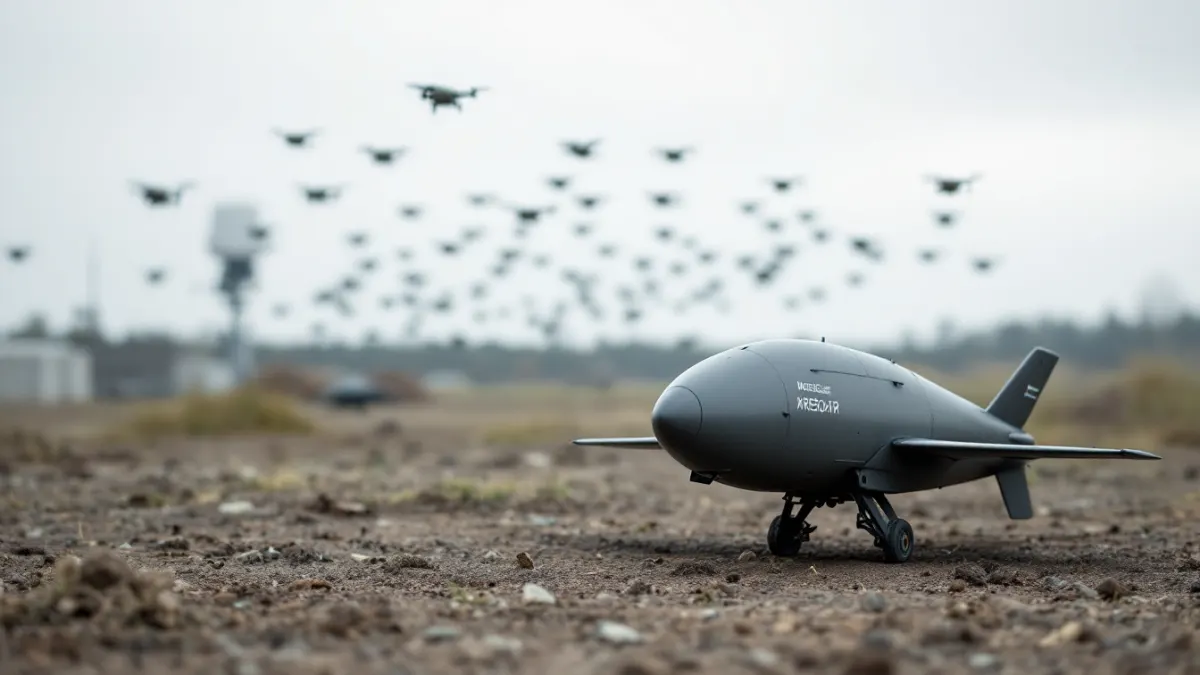
While global military contractors focus on costly, complex drone defenses, Sweden is quietly redefining air defense with a simple, low-cost solution. Nordic Air Defence (NAD), a startup based in Stockholm, developed the Kreuger-100XR, a football-sized mini-missile designed to counter drone swarms for just a few thousand dollars each. This isn’t just cheaper hardware—it’s a strategic shift toward scalable, autonomous defense ecosystems.
In 2025, European authorities selected NAD as a finalist in a Frontex counter-drone contest, recognizing its potential to outmaneuver traditional defense giants like MBDA and Lockheed Martin. The real edge? NAD’s interceptor trades expensive multi-motor designs for a single propeller capable of 220 mph speeds and 20-minute loitering, allowing it to hunt drones with minimal infrastructure.
“If we are attacked by a swarm of drones, we need a swarm of counter-drones,” says NAD’s business development director, Jens Holzapfel. This insight reveals the leverage mechanism: low-cost, mass-deployable interceptors that operate autonomously multiply defense capacity without ballooning budgets.
Military leverage no longer requires giant budgets or complex hardware—it requires system-level simplicity and scalability.
Why Cost-Driven Defense Models Miss Leverage
Conventional wisdom expects air defense to scale by investing in expensive, multi-motor interceptors costing hundreds of thousands per unit. MBDA’s eight-motor interceptors and legacy primes reflect this high-cost, high-complexity model. Analysts often view startups like NAD as cost-cutters trying to disrupt this expensive norm.
But this misses the fundamental constraint shift NAD exploits: the need to overwhelm drone swarms with numbers, not just precision. Unlike traditional interceptors, the Kreuger-100XR sacrifices extended range (about two miles) for dramatically reduced cost and operational simplicity. This constraint repositioning creates a system where deployability and quantity trump single-shot sophistication—a nuance process improvement can amplify further.
Unlike rigid, bureaucratic primes, NAD’s 23-person team leverages rapid prototyping and 3D printing within their Stockholm office, accelerating iteration cycles and lowering barriers to deployment. This lean structure contrasts sharply with Lockheed Martin’s 121,000 employees, where complexity inflates cost and slows innovation.
How Simple Design Drives Scalable Autonomy
The Kreuger-100XR uses foldable carbon fiber wings and a single propeller to hit speeds above 220 mph—faster than the typical 115 mph Russian Shahed-136 attack drones it targets. Its design enables it to either be thrown by hand or launched via a catapult, meaning frontline personnel can deploy swarms from backpacks without specialized equipment.
This low logistical footprint is a critical leverage point. Traditional interceptors like Stingers cost $480,000 each and require complex launch platforms. NAD reduces this to a few thousand dollars, enabling mass production and widespread field deployment. The 20-minute loiter capability, enabled by the foldable wings, allows the interceptor to wait autonomously for targets—moving defense from reactive to proactive.
The interceptor’s autonomous camera and optional 250-gram warhead reflect systemic cost prioritization, focusing expenses where they maximize tactical impact. NAD’s plan for a laser seeker adaptation further extends options under different operational constraints.
Strategic Implications for European and Global Defense
By addressing the drone swarm threat with numbers and autonomy, Sweden’s NAD changes the defense equation. The startup’s plan to conduct trials in Ukraine—where drone warfare is intense—tests the system’s real-world leverage before full rollout.
This approach suggests new strategic moves for defense agencies worldwide: pivot from exclusive reliance on costly, complex missiles to embracing swarming mini-interceptors producible with largely automated supply chains across Europe, North America, Japan, and South Korea.
Countries with constrained defense budgets can leapfrog legacy systems and deploy drone swarm counters at scale, akin to how emerging markets exploit resource optimization to achieve disproportionate gains.
“Scaled, autonomous counter-drone swarms redefine the economy of warfare,” Holzapfel states. This forces a rethink: it’s not about outspending adversaries but out-deploying and out-automating them.
For operators and strategists, the Kreuger-100XR teaches a vital lesson: leverage comes not only from cutting costs but from rearchitecting the constraints around scale, autonomy, and deployment simplicity.
Related Tools & Resources
The strategic shift toward scalable, autonomous defense systems discussed in the article highlights the need for clear, repeatable operational workflows. For organizations looking to document and optimize their processes—whether in defense or business—Copla offers a powerful solution to create and manage standard operating procedures effectively. Embracing the same lean, process-driven mindset can unlock new levels of operational leverage. Learn more about Copla →
Full Transparency: Some links in this article are affiliate partnerships. If you find value in the tools we recommend and decide to try them, we may earn a commission at no extra cost to you. We only recommend tools that align with the strategic thinking we share here. Think of it as supporting independent business analysis while discovering leverage in your own operations.
Frequently Asked Questions
What are the advantages of using mini-missiles like the Kreuger-100XR for drone defense?
Mini-missiles like the Kreuger-100XR offer a low-cost solution at just a few thousand dollars each, enabling mass deployment against drone swarms. Their simple design with a single propeller achieving speeds over 220 mph allows scalable, autonomous defense without requiring complex infrastructure.
How do mini-missiles compare to traditional interceptors in terms of cost and deployment?
Traditional interceptors, such as MBDA's eight-motor missiles or Stinger missiles costing around $480,000 each, are expensive and require complex launch systems. In contrast, the Kreuger-100XR costs only a few thousand dollars, can be launched by hand or catapult, and supports widespread field deployment with minimal logistics.
What role does autonomy play in the effectiveness of counter-drone mini-missiles?
Autonomy allows mini-missiles to loiter for 20 minutes and wait for targets, enabling proactive defense. The Kreuger-100XR uses autonomous cameras and can be equipped with optional warheads, multiplying defense capacity through system-level simplicity.
Why is scaling by quantity more effective than by high-cost precision in drone defense?
Overwhelming drone swarms requires multiple interceptors; thus, deploying numerous low-cost mini-missiles is more effective than relying solely on a few expensive, complex interceptors. This system-level shift favors quantity and deployability over extended range or single-shot sophistication.
How has NAD's company structure contributed to its innovation in air defense?
NAD’s 23-person team uses rapid prototyping and 3D printing within their Stockholm office to accelerate iteration cycles. This lean structure contrasts with legacy giants like Lockheed Martin with 121,000 employees, enabling faster innovation and lower costs.
What strategic implications does the use of mini-missiles have for global defense budgets?
Mini-missiles allow countries with constrained defense budgets to deploy scalable, autonomous counter-drone systems affordably. This approach enables leapfrogging legacy expensive systems by adopting largely automated supply chains and mass production of low-cost interceptors.
How fast can the Kreuger-100XR fly compared to typical attack drones?
The Kreuger-100XR can reach speeds exceeding 220 mph, which is nearly double the speed of typical Russian Shahed-136 attack drones that fly around 115 mph, giving it a tactical advantage in interceptions.
What is the significance of NAD being a finalist in the 2025 Frontex counter-drone contest?
Being selected as a finalist demonstrates NAD’s Kreuger-100XR has strong potential to compete with traditional defense giants like MBDA and Lockheed Martin, highlighting its innovative and cost-effective approach to counter-drone technology.