
How Trump’s Battleship Design Challenges Naval Modernization Logic

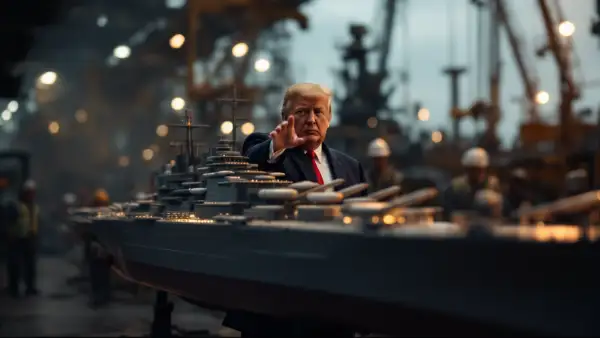
President Donald Trump has announced a plan to co-lead the design of a new class of massive warships with the U.S. Navy, promising a fleet “100 times more powerful” than any battleship ever built. This new ship aims to outsize and outgun World War II-era Iowa-class battleships, integrating futuristic weapons like hypersonic missiles, rail guns, and lasers that remain developmental Navy projects. But this isn’t just about big ships—it's about imposing aesthetic control over complex military procurement, potentially upending how naval systems evolve under modern constraints. “Design control is leverage over operational reality,” and Trump’s insistence on shaping warship looks reveals a deeper play on leverage in military-industrial systems.
Why Bigger and Flashier Isn’t the Navy’s Real Constraint
Conventional wisdom holds that bigger, more powerful ships are the backbone of naval strength. The Navy’s historic shift away from battleships towards aircraft carriers and missile systems reflects this belief. Yet recent failures to deliver on cutting-edge vessels like the Ford-class carriers and Columbia-class submarines reveal that cost overruns and timeline delays are the binding constraints—not technology alone. Trump’s plan to build enormous, weapon-loaded battleships ignores this fundamental bottleneck. It assumes more design complexity and novel tech accelerate advantage rather than escalate risks.
This challenge to standard modernization mirrors themes from our analysis on structural leverage failures in tech layoffs, where flawed system design limits scaling despite abundant resources. Trump’s focus on aesthetic design and outdated battleship concepts risks reinforcing constraints instead of repositioning them.
How Command over Design Aims to Reposition Naval Constraints
Trump’s direct role in the ship’s design signals a strategic move to seize decision-making leverage away from specialized naval engineers. By emphasizing “beauty” and “aesthetic” aspects, he taps into a psychological and bureaucratic lever: controlling form to influence function and morale. Historically, battleships symbolized national power with imposing presence—reclaiming that symbolism in a futuristic form challenges the “invisible” complexity modern naval tech demands.
Unlike the previously scrapped Constellation-class frigate and the Navy’s pivot to modified Coast Guard cutters, a Trump-led design could shortcut typical iterative engineering processes. However, this shortcut risks ignoring deep integration issues found in ships like the Ford-class aircraft carriers, known for their electromagnetic launch systems. The decision to reinstate obsolete technology resembles Trump’s prior push to ditch electromagnetic catapults for steam-powered ones, reflecting a preference for control over evolutionary systems.
Our recent coverage on OpenAI’s scaling of ChatGPT highlights the opposite approach: letting system infrastructure evolve autonomously without micro-managing aesthetics, speeding deployment and reducing complexity. Trump’s approach breaks with that model, betting on top-down design control as gearing future naval leverage.
Why Naval Operators Must Anticipate Constraint Repositioning in Military Tech
The real constraint changing here is who controls design choices in complex defense systems. This shift from engineering-led to personality-driven design alters leverage points in the supply chain, procurement timelines, and funding priorities. Operators must watch this because it can lock the Navy into outdated paradigms that inflate costs and delays, rather than streamline capability development.
Other countries with growing naval ambitions, like China and India, focus on modular design and incremental upgrades, effectively lowering system integration risk. They leverage automation and platform interoperability over mere size or aesthetic approval. The U.S. Navy’s ability to maintain a technological edge depends on reclaiming that systems mindset.
“Leverage is rarely about size—it’s about constraint control,” and whoever dictates design fundamentally influences execution. Trump’s battleship plan is a spotlight on how leverage can slip from system optimization into symbolic assertion, with cascading operational risks.
Related Tools & Resources
As we explore the complexities in naval design and decision-making, the principles of AI can also transform how we manage and streamline processes. Tools like Blackbox AI can empower developers and engineers by automating coding tasks, allowing them to focus on innovative solutions rather than getting bogged down by routine code generation. Learn more about Blackbox AI →
Full Transparency: Some links in this article are affiliate partnerships. If you find value in the tools we recommend and decide to try them, we may earn a commission at no extra cost to you. We only recommend tools that align with the strategic thinking we share here. Think of it as supporting independent business analysis while discovering leverage in your own operations.
Frequently Asked Questions
What is the main goal of Trump’s battleship design plan?
Trump aims to co-lead the design of a new class of warships with the U.S. Navy, promising a fleet "100 times more powerful" than any battleship ever built by integrating futuristic weapons like hypersonic missiles, rail guns, and lasers.
How does Trump’s battleship plan challenge traditional naval modernization?
The plan challenges the conventional shift from battleships to aircraft carriers and missile systems by emphasizing large, aesthetically controlled warships, potentially increasing risks related to cost overruns and timelines rather than addressing these constraints.
What are the real constraints in modern naval shipbuilding?
The primary constraints are cost overruns and timeline delays, as seen with Ford-class carriers and Columbia-class submarines, rather than purely technological limitations.
Why does control over ship design matter in military technology?
Control over design shifts leverage points in procurement, timelines, and funding, influencing operational reality and potentially locking the Navy into outdated paradigms.
How does Trump’s approach to naval design differ from other countries like China and India?
Other countries focus on modular design and incremental upgrades that lower integration risks, while Trump’s approach emphasizes top-down design control and aesthetics rather than system evolution and interoperability.
What risks come with reintroducing obsolete technologies in new naval ships?
Reinstating obsolete tech, such as steam-powered catapults over electromagnetic ones, risks ignoring complex integration issues and may inflate costs and delays.
How do AI tools like Blackbox AI relate to naval modernization challenges?
AI tools like Blackbox AI help streamline and automate complex processes in development, which contrasts with Trump’s focus on micromanaging design aesthetics that may increase complexity.
What does "leverage" mean in the context of naval design and military tech?
"Leverage" refers to controlling constraints and decision-making points that impact system integration, cost, and operational effectiveness, rather than just size or power.