
How Trump’s 'Trump-Class' Ships Change Naval Power Dynamics

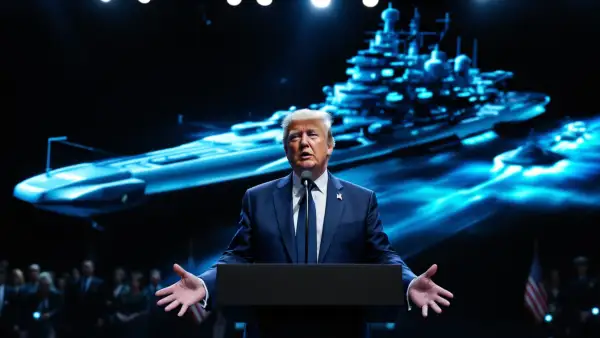
Modern naval fleets cost billions to develop and operate, with traditional battleships phased out decades ago. President Donald Trump recently announced two new "Trump-class" ships for the US Navy’s so-called "Golden Fleet", describing them as AI-controlled battleships equipped with lasers and designed under Navy leadership with his aesthetic input.
This move isn’t about nostalgia for large warships—it’s about redefining force projection through autonomous systems and creating new operational leverage for the US Navy.
Unlike conventional naval procurement, embedding advanced AI control and directed-energy weapons suggests a shift from human-centric systems to automated, persistent naval power. Powerful navies that master AI-driven assets dominate maritime influence without exponential crew costs.
Why Battleships Are Not Just Back—They're Automated
Conventional wisdom says battleships are obsolete: high cost, crew complexity, and vulnerability make aircraft carriers and missile ships preferable. This narrative sees battleships as a dated relic.
That assumption ignores the leverage of combining AI autonomy with new weapons tech. Modern Trump-class ships aim to remove human constraints—such as crew limits and reaction times—allowing continuous, rapid engagement beyond traditional capacities.
This challenges legacy naval design norms, much like how some robotics firms disrupt manual labor by automating scale. It's constraint repositioning, shifting from manpower to machine endurance and precision.
AI-Control and Lasers: A Force Multiplier in Naval Systems
Examples like the increasing use of drones in Ukraine show how autonomy extends military capability massively without proportional human cost. Trump-class ships promise similar leverage at sea.
Unlike traditional missile platforms requiring extensive logistics, laser weapons deliver near-infinite 'ammunition' at the speed of light, drastically reducing resupply constraints.
The US Navy leading the design ensures system integration at scale, while Trump's aesthetic input signals an intent for recognizable brand and morale impact.
This contrasts with competitors relying on incremental upgrades of conventional fleets, which lack such autonomous offensive capacity. It echoes how OpenAI scaled ChatGPT—not by small tweaks, but by redesigning control systems for explosive growth.
What This Means for Naval Strategy and Global Power
The key constraint shifting is human operational overhead, replaced by AI-driven persistence and automation. This frees the Navy to deploy more assets with fewer personnel, cutting long-term costs and increasing presence.
Observers in allied navies and competitors in Asia-Pacific should watch closely—this could set a new standard for force leverage without proportional spending increases.
Further, integrating advanced weapons and AI control turns traditional fleet size metrics obsolete, forcing rivals to rethink procurement under new constraints.
"Automated naval power rewrites the rules of endurance and engagement speed at sea." This transition echoes broader military shifts highlighted in our analysis of drone proliferation, where automation leads to asymmetric advantages.
Related Tools & Resources
As the article highlights the transformative impact of AI on naval power and operations, the relevance of innovative AI tools like Blackbox AI becomes clear. For developers and tech enthusiasts looking to leverage AI capabilities in various fields, Blackbox AI offers powerful code generation and assistance that can help bridge the gap between manual coding efforts and the automation revolution in industries, including defense. Learn more about Blackbox AI →
Full Transparency: Some links in this article are affiliate partnerships. If you find value in the tools we recommend and decide to try them, we may earn a commission at no extra cost to you. We only recommend tools that align with the strategic thinking we share here. Think of it as supporting independent business analysis while discovering leverage in your own operations.
Frequently Asked Questions
What are Trump-class ships?
Trump-class ships are newly announced AI-controlled battleships equipped with laser weapons, designed for the US Navy with President Donald Trump’s aesthetic input, aiming to redefine naval force projection.
How do AI-controlled ships change naval operations?
AI control removes human crew limitations and reaction times, allowing continuous and rapid engagement, reducing operational overhead, and increasing persistence and efficiency at sea.
Why are lasers considered a game changer for naval weapons?
Laser weapons provide near-infinite ammunition at the speed of light, drastically reducing the need for logistic resupply compared to traditional missile platforms.
How do Trump-class ships compare to traditional naval fleets?
Unlike traditional fleets that rely on large crews and incremental upgrades, Trump-class ships use autonomous systems to cut personnel needs and boost sustained offensive capabilities.
What impact could Trump-class ships have on global naval strategy?
The shift to AI-driven naval power reduces human costs, enabling more assets deployment and forcing rivals to rethink procurement strategies based on AI autonomy rather than fleet size.
Are there parallels between Trump-class ships and other AI military advancements?
Yes. Similar to how drones in Ukraine showcased autonomy’s force multiplier effect, Trump-class ships apply AI and lasers for persistent and efficient naval dominance.
What is the significance of the US Navy leading the design?
The US Navy’s leadership ensures system integration at scale, combining advanced AI and directed-energy weapons with strategic operational leverage and morale impacts.
How many Trump-class ships were announced and when?
President Donald Trump announced two new Trump-class ships recently, as reported in December 2025.