
Saudi Arabia Opens MENA’s First Humanoid Robotics Showroom

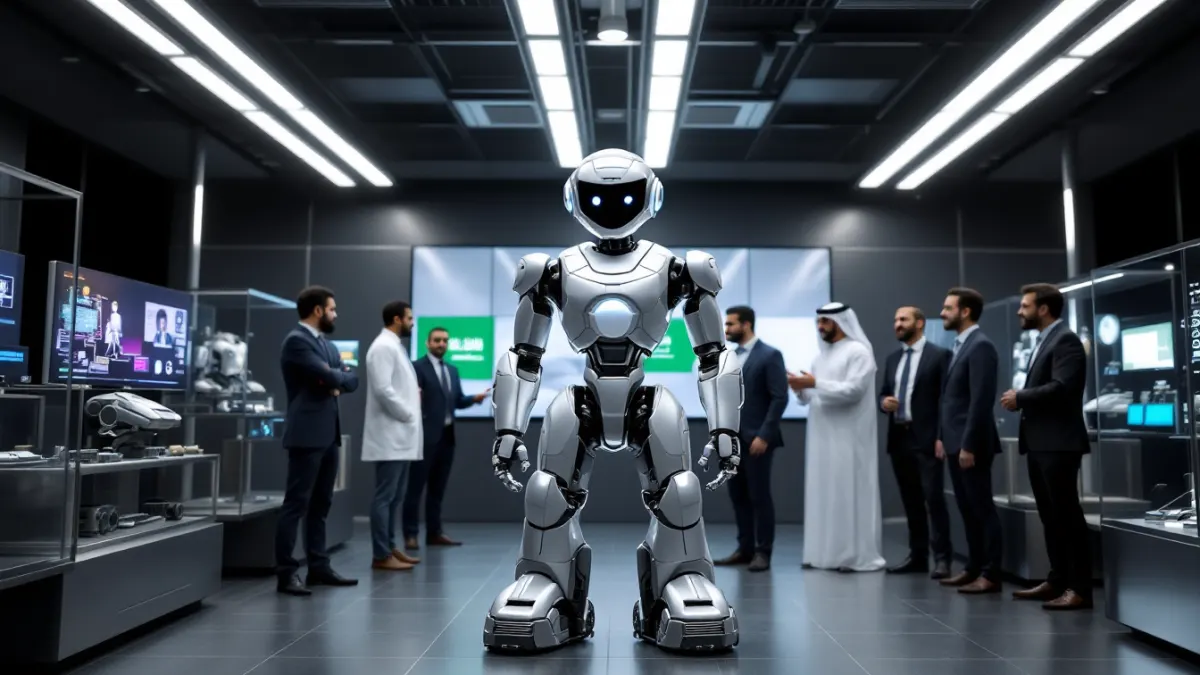
While global robotics adoption faces long development cycles, Saudi Arabia accelerates humanoid deployment with its first dedicated showroom in Riyadh. Humanoid, a UK-based AI company, partnered with QSS AI & Robotics to launch this hub in November 2025, showcasing the HMND 01 Alpha Wheeled, the UK’s first industrial humanoid robot. This is more than a showroom—it’s a controlled ecosystem designed to scale humanoid use rapidly across sectors.
Countries that engineer deployment platforms, not just prototypes, unlock systemic automation advantages.
Contrary To Expectations, Middle East Robotics Isn’t Just About Imports
Common narratives paint the Middle East as a technology consumer reliant on imports. Saudi Arabia challenges this by localizing assembly at Riyadh Robotics Factory through QSS AI & Robotics. This isn’t about buying finished robots; it’s about strategically building a manufacturing base aligned with Vision 2030.
Unlike regions focused solely on robot development prototypes, Saudi Arabia invests in shift-to-scale infrastructure, a mechanism that repositions legacy supply chain constraints. How Robotics Firms Are Quietly Bringing 10M Robots Into Daily Life offers insight into how manufacturing localization breaks adoption bottlenecks.
Building A Pre-Order Framework To Flip Adoption Constraints
Humanoid and QSS committed to pre-ordering up to 10,000 units over five years, a volume rarely seen in humanoid robotics. This advance ordering secures production leverage, turning what is conventionally a slow market entry into a pipeline with predictable demand and rapid industrial rollout.
In contrast, most robotics firms depend on fragmented, single-project sales that stall scaling. Humanoid built the HMND 01 Alpha Wheeled in seven months—one of the fastest development cycles—allowing for immediate field validation. This agility compresses the time-to-leverage by shrinking the design-to-deploy timeline.
Strategic Positioning Creates A Regional Robotics Hub
By partnering with Saudi manufacturing and aligning with Vision 2030, Humanoid leverages government incentives and infrastructure development, turning geopolitical positioning into operational advantage. The regional market’s projected growth from $178.2 million in 2024 to nearly $543.7 million by 2033 reflects a rising demand curve that underwrites large-scale automation investment.
Unlike markets in Western Europe or United States, where legacy workforce structures slow robot deployment, Saudi Arabia sets itself apart through purpose-built ecosystems. Why AI Actually Forces Workers To Evolve Not Replace Them sheds light on this labor-technology balance.
What This Means For Global Robotics Operators
The core constraint flipped here is not robot capability, but system readiness: manufacturing capacity coupled with market commitment. Operators focused on humanoid deployment must prioritize local ecosystem creation to scale rapidly without regulatory drag or supply bottlenecks.
Saudi Arabia's showroom is a physical and strategic lever, turning robotics from isolated tech experiments into integrated infrastructure. Competitors ignoring such system design will face higher customer acquisition and slower deployment.
How OpenAI Actually Scaled ChatGPT To 1 Billion Users parallels this approach by showing the power of combining technology rollout with ecosystem leverage.
Related Tools & Resources
As Saudi Arabia develops its manufacturing capabilities in robotics, tools like MrPeasy become essential for maintaining efficiency in production management. By leveraging a manufacturing ERP like MrPeasy, businesses can streamline their operations, ensuring they meet increasing demands for humanoid robots with precision and speed. Learn more about MrPeasy →
Full Transparency: Some links in this article are affiliate partnerships. If you find value in the tools we recommend and decide to try them, we may earn a commission at no extra cost to you. We only recommend tools that align with the strategic thinking we share here. Think of it as supporting independent business analysis while discovering leverage in your own operations.
Frequently Asked Questions
What is Saudi Arabia's role in accelerating humanoid robotics deployment?
Saudi Arabia accelerates humanoid robotics deployment by opening the MENA region's first dedicated showroom in Riyadh and localizing assembly through the Riyadh Robotics Factory, supporting Vision 2030 goals.
What makes the HMND 01 Alpha Wheeled robot significant?
The HMND 01 Alpha Wheeled is the UK’s first industrial humanoid robot, developed in just seven months, enabling rapid field validation and faster time-to-market in industrial applications.
How does pre-ordering affect the robotics market?
Pre-ordering up to 10,000 humanoid robots over five years creates production leverage, ensuring predictable demand and accelerating industrial adoption compared to fragmented single-project sales.
What distinguishes Saudi Arabia's robotics ecosystem from Western markets?
Saudi Arabia's purpose-built robotics ecosystems and government incentives under Vision 2030 facilitate large-scale automation faster than Western Europe or the US, where legacy workforce structures slow deployment.
What is the projected market growth for robotics in the Middle East?
The Middle East robotics market is projected to grow from $178.2 million in 2024 to nearly $543.7 million by 2033, driven by increasing demand and strategic investments.
How does manufacturing localization impact robotics adoption?
Localizing manufacturing, as Saudi Arabia does through QSS AI & Robotics, breaks adoption bottlenecks by aligning production with market needs, reducing dependency on imports and speeding deployment.
Why is system readiness more critical than robot capability in humanoid robotics?
System readiness, including manufacturing capacity and market commitment, is key to scaling humanoid robotics rapidly, minimizing regulatory drag and supply chain constraints.
How does Saudi Arabia's robotics showroom support global robotics operators?
The showroom acts as a strategic lever integrating robotics into infrastructure, helping operators rapidly scale deployments through local ecosystem creation and predictable volume orders.