
What GravityXR’s Apple-Rival Chip Reveals About China’s XR Leap

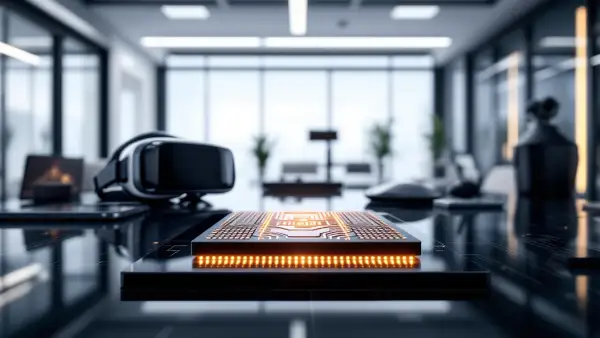
China is betting on XR to break the global tech chip oligopoly dominated by Apple, Qualcomm, and Meta. GravityXR, a Chinese startup founded by ex-Apple engineer Wang Chaohao, unveiled last week the Jizhi G-X100, the country’s first 5-nanometre all-in-one mixed reality chip. This move signals more than hardware competition—it exposes China’s push to control XR’s system-level leverage. Who owns XR chips decides the next tech frontier’s architecture and ecosystem.
Challenging the Chip Cost Arms Race Misconception
Conventional analysis brands XR chip design as a brutal cost and speed contest, with winners simply making faster processors. They overlook the deeper leverage: system consolidation. GravityXR’s Jizhi G-X100 combines multiple XR and AI functions, reducing dependency on fragmented suppliers. This breaks the model followed by Apple’s Vision Pro and Qualcomm’s XR chips, which rely on complex multi-chip architectures and multiple vendors.
This is a structural constraint repositioning, not just incremental performance gains. See how past tech layoffs revealed hidden leverage failure in
why 2024 tech layoffs actually reveal structural leverage failures.
The System-Integrated Chip Makes XR Ecosystems Easier to Scale
The Jizhi G-X100, using advanced 5-nanometre process technology, is not just a speed upgrade. It’s designed to work with AI glasses and mixed reality headsets integrating vision processing, AI inference, and communications within a single chip. This reduces power draw, latency, and cost per unit substantially.
Unlike competitors who invest billions acquiring IoT or AR firms to stitch together a patchwork stack, GravityXR’s approach centralizes XR capabilities into one chip, bypassing costly supply chain complexity. This drops hardware economics closer to software-driven XR rollouts, enabling cheaper, faster XR adoption in Chinese markets.
Contrast this with Apple’s Vision Pro launch, which relied on multiple chipsets and software layers forcing costly production cycles and slower iteration.
Relatedly, how OpenAI actually scaled ChatGPT to 1 billion users highlights that scaling leverage requires system simplicity. This chip consolidation in XR hardware is the parallel at the silicon level.
China’s Move Cuts XR Entry Barriers and Unlocks Ecosystem Control
The real constraint shift is that a native Chinese chip stack no longer forces manufacturers into expensive foreign royalties or supply dependencies. It also enables China’s growing AI and metaverse firms to build XR experiences optimized end-to-end on a single hardware-software platform.
Other countries and companies locked into multi-chip vendor models pay higher acquisition and integration costs, slowing iteration and increasing market entry friction. This smart repositioning of hardware constraints effectively turns national policy into tech leverage.
Why Bank of America warns China’s monetary aggregates secretly signal risk dives into how financial levers reflect these structural plays beyond hardware.
China’s GravityXR Move Signals a New Chapter for XR Control
The hardware constraint that defined XR growth—multi-vendor, costly chip supply—has quietly shifted in China. This unlocks faster XR device scale specifically for local producers and brands that build atop GravityXR’s Jizhi G-X100.
Operators outside China should watch this as a leverage play that changes the XR competitive field. Replicating requires years embedding chip design inside XR ecosystem formation, not just chasing hardware specs.
In XR, mastering system-level chip leverage beats chasing silicon speed alone.
Related Tools & Resources
As companies like GravityXR revolutionize XR chip design, integrating AI into their processes will be crucial. Tools like Blackbox AI can empower developers with advanced coding assistance, enabling them to streamline AI integration into XR applications, thus leveraging the current technological shifts effectively. Learn more about Blackbox AI →
Full Transparency: Some links in this article are affiliate partnerships. If you find value in the tools we recommend and decide to try them, we may earn a commission at no extra cost to you. We only recommend tools that align with the strategic thinking we share here. Think of it as supporting independent business analysis while discovering leverage in your own operations.
Frequently Asked Questions
What is GravityXR's Jizhi G-X100 chip?
The Jizhi G-X100 is China’s first 5-nanometre all-in-one mixed reality chip, integrating vision processing, AI inference, and communications to reduce power, latency, and costs in XR devices.
How does GravityXR's chip differ from Apple's Vision Pro chip architecture?
Unlike Apple’s Vision Pro which uses multiple chipsets and software layers, GravityXR's Jizhi G-X100 consolidates multiple XR and AI functions into a single chip, simplifying supply chains and lowering production costs.
Why is system consolidation important in XR chip design?
System consolidation reduces dependency on fragmented suppliers and cuts costs, power draw, and latency. GravityXR’s approach emphasizes system-level leverage rather than just processor speed.
How does China’s native XR chip stack impact the global market?
A native Chinese chip stack like GravityXR’s reduces foreign royalties and supply dependencies, enabling faster XR device adoption in China and potentially shifting global XR ecosystem control.
What advantages does the Jizhi G-X100 chip offer for AI glasses and mixed reality headsets?
The chip integrates advanced 5nm process technology to deliver enhanced vision processing, AI inference, and communications within one chip, improving efficiency and reducing unit costs for XR devices.
How does GravityXR’s approach differ from competitors’ investments in XR?
GravityXR centralizes XR capabilities into a single chip, avoiding costly acquisitions of IoT or AR firms to build patchwork stacks, contrasting with competitors who rely on multi-chip vendor models.
What is the significance of China’s XR chip development for international companies?
China’s move signals a hardware constraint shift that could accelerate XR device scaling locally and challenges international companies to embed chip design deeply in ecosystem formation to compete effectively.