
What the US Navy’s Drone Launch Reveals About Modern Maritime Power

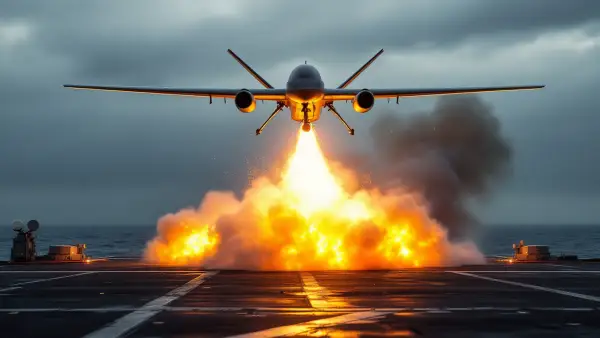
The rise of one-way attack drones shifts the cost of maritime power in the Middle East dramatically. The US Navy’s recent launch of the LUCAS drone from the USS Santa Barbara marks a transition from expensive missiles to scalable, low-cost autonomous strike assets. This isn’t simply a new weapon—it’s a system that rewrites naval leverage by combining affordability with operational reach. “Affordable drones multiply force without multiplying cost or risk,” says Vice Adm. Curt Renshaw.
Why more firepower is not the real story here
Conventional analysis treats this launch as incremental armament expansion: naval vessels adding drones to their arsenal. That view misses the systemic shift in the core constraint — cost and deployment speed. Instead of expensive, multi-million-dollar missiles requiring complex logistics, LUCAS is a sub-$50,000 drone deployable from small ships and mobile stations. This is constraint repositioning, not escalation.
Unlike traditional naval strike systems, the drone’s one-way loitering munition design prioritizes quantity and saturation over individual precision. This approach undermines adversaries’ missile defenses by forcing them to counter hundreds of cheaper, expendable targets. The Pentagon’s $1 billion push to field hundreds of thousands of these drones across forces reveals a strategic bet on scalable automation, a mechanism rarely emphasized in analyses. Ukraine’s drone usage surge shows how cost rewriting reshapes conflict dynamics.
LUCAS vs. traditional alternatives: speed, cost, and deployment flexibility
The Independence-class littoral combat ship launching LUCAS signals a move toward small, versatile platforms operating alongside traditional carriers. Whereas costly cruise missiles demand large vessels and extensive prep, LUCAS’s catapult and rocket-assisted takeoff allow rapid deployment from mobile, lower-profile assets. This unlocks new maritime tactics by detaching firepower from platform complexity.
By contrast, the Russian Geran-2 and Iranian-made Shahed-136 provide precedents but lack the US Navy’s integration with mobile catapult systems and naval task forces. The US approach bundles low-cost drones with fast distribution and regional task forces, creating a compound advantage few nations can replicate quickly. This contrasts with older missile strategies that compete primarily on individual weapon sophistication rather than quantity and networked effects.
Why the Middle East is the proving ground for drone leverage
Deploying the first dedicated one-way attack drone squadron in the Middle East exploits a geostrategic bottleneck. Regional threats rely heavily on asymmetrical drone attacks, making drone defense and offense a contested space. The US’s move embeds affordable autonomous strike as a layered deterrent against evolving drone and missile attacks.
This regional specialization also shows how strategic leverage depends on matching system design to operational environment constraints. The Arabian Gulf’s geography and threat landscape force a rethink of naval warfare fundamentals, privileging drones that can loiter, saturate, and strike with little footprint or preparation.
What operators must watch next
The core constraint has shifted from expensive hardware to cheap, widely deployable autonomous systems. Operators who understand drone force as an infrastructure platform—not just a weapon—will build lasting leverage. This enables continuous presence, rapid re-tasking, and cost-effective attrition warfare.
Other navies and regions will need to follow the US lead or risk losing tactical deterrence in drone-saturated waters. This development parallels broader automation trends reshaping military logistics and force composition globally. The Independence-class shift exemplifies not just hardware upgrades but systemic redesign.
“Leverage isn’t added firepower — it’s the ability to sustain and multiply effects without multiplying costs.”
Related Tools & Resources
As the landscape of military strategy evolves towards cost-effective and scalable solutions, businesses must also adapt their analytics game to leverage marketing efficiency. Tools like Hyros can empower marketing teams to optimize their ad spend and ensure every dollar works harder, just as the US Navy is maximizing its automation in maritime warfare. Learn more about Hyros →
Full Transparency: Some links in this article are affiliate partnerships. If you find value in the tools we recommend and decide to try them, we may earn a commission at no extra cost to you. We only recommend tools that align with the strategic thinking we share here. Think of it as supporting independent business analysis while discovering leverage in your own operations.
Frequently Asked Questions
What is the significance of the US Navy's LUCAS drone launch?
The US Navy's launch of the LUCAS drone from the USS Santa Barbara marks a shift from expensive missiles to low-cost, scalable autonomous strike systems costing under $50,000 each, reshaping naval power dynamics.
How does the LUCAS drone differ from traditional naval strike weapons?
Unlike costly cruise missiles, LUCAS drones prioritize quantity and saturation with one-way loitering munition design. They can be rapidly deployed via catapult systems from small ships, allowing for faster, more flexible maritime operations.
Why is the Middle East a key region for drone deployment?
The Middle East, especially the Arabian Gulf, serves as a strategic proving ground due to its unique geography and asymmetric drone threat landscape, making it ideal for deploying one-way attack drone squadrons as layered deterrents.
How many drones does the Pentagon plan to field, and what is the budget?
The Pentagon is investing approximately $1 billion to field hundreds of thousands of drones across its forces, emphasizing scalable automation over individual weapon sophistication.
How does the US Navy's approach compare to similar drones like the Russian Geran-2?
While drones like the Russian Geran-2 and Iranian Shahed-136 exist, the US Navy combines low-cost drones with mobile catapult launch systems and regional task forces, creating a compound advantage in speed, cost, and deployment flexibility.
What advantages do Independence-class littoral combat ships provide for drone deployment?
These small, versatile ships enable the launch of LUCAS drones via catapult and rocket-assisted takeoff, allowing rapid deployment from lower-profile platforms rather than depending on large vessels and complex logistics.
What should operators consider for future drone force utilization?
Operators should view drones as an infrastructure platform enabling continuous presence, rapid retasking, and cost-effective attrition warfare instead of just weapons, adapting to shifting constraints favoring cheap, deployable autonomous systems.
How does the drone strategy reflect broader military trends?
The US Navy's drone strategy aligns with global trends toward automation in military logistics and force composition, prioritizing cost-effective scalable solutions over traditional hardware upgrades.