
What Tsinghua’s Robotics Institute Reveals About China’s AI Race

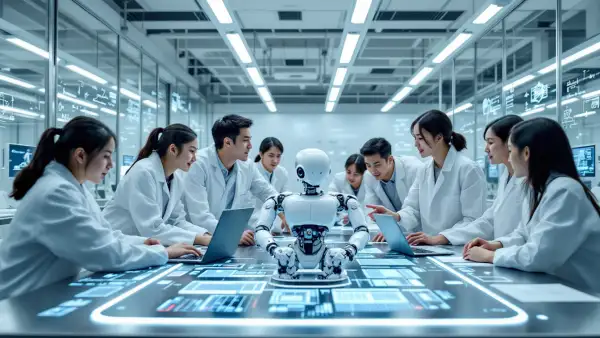
China’s leadership in robotics is struggling to break traditional academic silos despite massive investments. Tsinghua University just launched the Institute for Embodied Intelligence and Robotics, integrating automation, mechanical, electronic, and computer science schools in December 2025.
But this move isn’t about research breadth—it’s a strategic pivot to create compounding advantage by fusing expertise across disciplines into a single innovation engine. China’s robotics push reveals that unified systems win over fragmented efforts.
Why Treating Robotics As Standalone Tech Limits China’s Progress
Conventional wisdom holds that robotics breakthroughs depend mainly on hardware or AI software independently. Analysts often promote deep specialization in narrow fields.
They overlook that robotics innovation demands synthesis across mechanical design, embedded control, and perceptual AI—isolated efforts create friction, duplicate failures, and slow iteration. This challenge echoes the structural leverage failures seen in big tech where scaling without integration caps returns.
How Tsinghua’s Cross-Disciplinary Model Redefines Leverage
By drawing together automation, mechanical engineering, electronic engineering, and computer science, Tsinghua consolidates resources, data, and talent pools. This dissolves interface delays and ensures feedback loops between hardware and embodied intelligence algorithms accelerate.
Unlike US institutions focusing on isolated AI labs or robotics departments, Tsinghua’s institute creates a multiplier effect, where innovations in one domain immediately inform others—this is not just collaboration, it’s a unified system design.
For example, a robotics perception algorithm updates in real-time based on mechanical testing, slashing R&D cycles by an estimated margin typically invisible to outside observers.
The Real Reason China Doubles Down on Embodied Intelligence
The constraint slowing Chinese robotics isn’t budget or talent scarcity; it’s the lack of integrated systems that generate self-reinforcing innovation cycles. Tsinghua’s move signals recognition of this leverage point.
This runs counter to Western assumptions that segmented research departments suffice—China’s unified institute reflects a position that embedding cross-disciplinary branches reduces coordination costs and magnifies impact over time.
This mirrors patterns seen in AI scaling, where OpenAI leveraged holistic system architecture over pure compute power. The institute could become the backbone for robotics startups and industrial OEMs, creating enduring competitive moats.
Who Gains and What Comes Next
China’s broader ecosystem in robotics must watch this integration closely. Countries like South Korea and Japan will face pressure to unify their own segmented university and industry research outputs or risk falling behind.
This shift changes how investors and operators assess robotics innovation—success hinges less on single breakthrough patents and more on structuring innovation as a feedback-driven platform.
“Control systemic integration, and you control the next frontier of AI-driven robotics.”
Related Tools & Resources
To fully realize the potential of cross-disciplinary robotics innovation, leveraging tools like Blackbox AI can streamline your development efforts. This AI-powered coding assistant enhances productivity by enabling rapid iteration and collaboration among various technical domains, which is essential for the unified systems design highlighted in the article. Learn more about Blackbox AI →
Full Transparency: Some links in this article are affiliate partnerships. If you find value in the tools we recommend and decide to try them, we may earn a commission at no extra cost to you. We only recommend tools that align with the strategic thinking we share here. Think of it as supporting independent business analysis while discovering leverage in your own operations.
Frequently Asked Questions
What is the Institute for Embodied Intelligence and Robotics at Tsinghua University?
The Institute for Embodied Intelligence and Robotics at Tsinghua University, launched in December 2025, integrates automation, mechanical, electronic, and computer science disciplines to foster unified robotics innovation.
Why is cross-disciplinary integration important in robotics research?
Cross-disciplinary integration in robotics research helps dissolve delays and accelerates feedback loops between hardware and AI algorithms, enabling faster R&D cycles as shown by Tsinghua’s unified approach.
How does China’s robotics strategy differ from Western approaches?
China emphasizes unified systems design by combining multiple engineering disciplines within one institute, unlike Western institutions which often have segmented AI or robotics labs, limiting innovation leverage.
What challenges does treating robotics as standalone technology create?
Treating robotics as standalone technology causes friction, duplicated failures, and slower iteration since innovation demands synthesis across hardware, control, and AI components.
How could Tsinghua’s institute impact robotics startups and industries?
The institute could serve as a backbone for robotics startups and industrial OEMs by creating self-reinforcing innovation cycles and reducing coordination costs, forming strong competitive advantages.
What lessons does Tsinghua’s model offer other countries like Japan and South Korea?
Japan and South Korea may need to unify their segmented research outputs to avoid falling behind, adopting more integrated approaches similar to Tsinghua’s for robotics innovation.
What role does embodied intelligence play in China’s AI race?
Embodied intelligence, combining AI perception with mechanical and electronic systems, is key to China’s strategy to achieve compounded innovation advantages in robotics.
What tools support cross-disciplinary robotics innovation as mentioned in the article?
Tools like Blackbox AI assist by streamlining coding and collaboration across disciplines, supporting the rapid iteration and unified systems design emphasized by Tsinghua’s institute.