
Why Tesla’s China Sales Rise Reveals A Market Leverage Shift

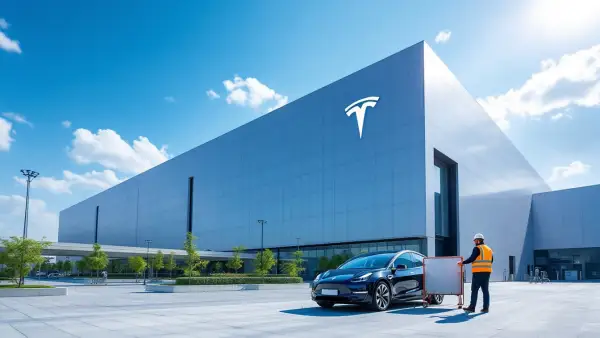
China’s electric vehicle market just flipped a rare script: Tesla saw its November sales rise nearly 10%, while its biggest Chinese rival BYD faced three straight months of declines. Despite a tough year marked by stalling growth in Europe and intense domestic competition, Tesla's Shanghai gigafactory reignited momentum by outpacing BYD’s November sales by 5%. Yet this win isn’t just a battle of monthly numbers—it signals a shift in how market constraints and pricing dynamics play out in China’s ultra-competitive EV ecosystem.
Unlike conventional analysis that frames Tesla's gains as an isolated rebound or consumer brand loyalty, the real story lies in China’s government crackdown on price wars and subsidy strategies that have reshaped competitive levers. BYD'sChina’s market constraints are not static—they’re systemically repositioning where strategic leverage lies.
Why pricing wars aren’t the ultimate sales drivers anymore
Common wisdom treats China’s EV market as a brutal price battleground controlled by aggressive discounting. BYD has dominated partly through affordable models and deep discounting, forcing rivals to bleed margins. But recent government clampdowns on aggressive discounting have shifted the competitive constraint.
This is where Tesla'sTesla’s safety innovations unlock autonomous operational leverage that competitors have yet to match.
Global expansion as a pressure valve for China sales constraints
While BYD stumbles at home, its overseas sales hit record highs, notably outselling Tesla two-to-one in Europe last October. This highlights a strategic divergence: BYD leverages affordable high-tech EVs internationally, broadening revenue and scaling production, which helps offset Chinese headwinds.
Tesla,BYD assumes expansion as an escape valve, while Tesla recalibrates via local production and pricing discipline, signaling distinctive system-level choices on what market pressure to bear.
Compare this to OpenAI’s scaling tactics, where infrastructure investment rather than user discounts changed leverage.
Why the sales bounce signals a deeper system resilience
Tesla'sstrategic constraint repositioning through technology and supply control.
By avoiding reliance on price cuts and instead doubling down on integrated production, Tesla turns a regulatory constraint into a competitive moat. This is operational leverage grounded in system design, not periodic promotional tactics.
For deeper context on how constrained environments reveal leverage failures, see our analysis of structural leverage failures in tech layoffs.
What this means for market positioning and competition
This sales uptick highlights a key constraint shift in China’s EV market: price cutting is no longer a lever for capturing volume growth. Instead, companies competing for dominance must master cost-efficient, flexible production systems and global diversification.
Tesla's Shanghai gigafactory exemplifies a system designed for autonomous leverage in cost, scale, and regulation navigation. Its ability to sustain sales growth in China despite fierce competition shows the power of margin control over discount dependency.
EV manufacturers ignoring this pivot face permanent margin pressure and limited growth prospects in China’s largest EV market. Meanwhile, investors and operators should track how China's regulatory constraint repositioning forces new market dynamics, reminiscent of how NVIDIA’s 2025 Q3 results quietly signaled investor shifts based on structural advantage.
“Sustained leverage is about controlling the system, not just winning the price war.”
Related Tools & Resources
As the competitive landscape in China's EV market becomes increasingly complex, the ability to harness precise sales intelligence is critical. Tools like Apollo empower sales teams with essential insights and contact data, allowing them to adapt strategies effectively and maintain a competitive edge. Learn more about Apollo →
Full Transparency: Some links in this article are affiliate partnerships. If you find value in the tools we recommend and decide to try them, we may earn a commission at no extra cost to you. We only recommend tools that align with the strategic thinking we share here. Think of it as supporting independent business analysis while discovering leverage in your own operations.
Frequently Asked Questions
Why did Tesla's sales in China rise nearly 10% in November?
Tesla's sales rise is attributed to its Shanghai gigafactory's vertical integration and global supply chain scale, allowing margin maintenance without heavy discounting, unlike competitors relying on subsidies and price wars.
How did BYD's sales perform in China compared to Tesla's in November?
BYD experienced three straight months of sales declines in China, with Tesla outpacing BYD's November sales by 5%, reflecting a shift in market leverage amid government crackdowns on discounting.
What impact has the Chinese government had on EV market pricing strategies?
The Chinese government cracked down on aggressive discounting and subsidy strategies, reducing the effectiveness of pricing wars and forcing EV manufacturers to focus more on cost-efficient production and system-level leverage.
How does Tesla's production system give it an advantage in China?
Tesla's Shanghai gigafactory uses vertical integration, automation, and software-enabled margin control to flex production and control costs, allowing it to compete without deep discounts.
Why is BYD's overseas growth significant?
While BYD faces domestic challenges, it achieved record overseas sales, notably outselling Tesla two-to-one in Europe last October, using affordable high-tech EVs to offset Chinese market constraints.
What does the shift away from price-cutting mean for the Chinese EV market?
The shift signals that volume growth will depend more on cost-efficient production systems and global diversification than on discounting, pressuring manufacturers reliant on subsidies and price wars.
How does Tesla's approach to market constraints differ from BYD's?
Tesla leverages local production with cost control and technology to reposition market constraints, whereas BYD treats global expansion as a pressure valve to offset domestic challenges.
What should investors watch for in China’s evolving EV market?
Investors should track how regulatory changes in China reposition competitive leverage, favoring companies like Tesla with system-level advantages over those dependent on discounting and subsidies.