
Why Trump’s Workforce Pell Shift Changes America’s Education Leverage

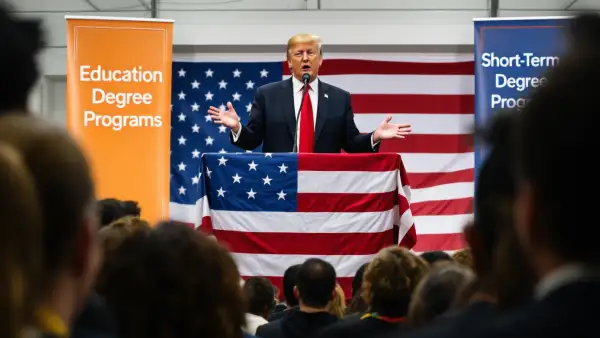
Student debt in America balloons past $1.7 trillion, fueling skepticism about traditional four-year degrees. The Department of Education recently finalized expanding Workforce Pell grants to short-term credential programs, a move set to launch in 2026.
This shift targets state-level tailoring of eligibility to meet local job market needs, positioning workforce education as a flexible alternative to costly college paths. But this isn’t just education reform — it’s a system re-architecture unlocking new leverage in labor markets.
Nicholas Kent, the department’s undersecretary, calls the four-year degree model “losing its value” amid rising costs and shifting employer demands. The real story: reallocating public funding to short-term programs compresses time-to-employment and debt exposure, resetting the fundamental constraint for educational leverage.
“Giving students agency to choose the path that pays off reduces lifetime cost and risk,” explains Chris Madaio from The Institute for College Access and Success. This recalibration of higher education financing strips away legacy constraints and rewires how workforce capital forms.
Why Four-Year Degrees Are Not the Only Leverage Point
Conventional wisdom holds that the four-year college degree is the gold standard for upward mobility, despite skyrocketing tuition and student loan defaults. Traditional lenders and policymakers have long doubled down on this system, but that ignores critical leverage constraints: time, cost, and uncertain job relevance.
This echoes systemic leverage failures we see in tech layoffs, where companies fail to adapt their talent systems Think in Leverage has analyzed. The entrenched model requires long human input cycles and massive debt loads, limiting scalability and increasing risk.
How Workforce Pell’s State-Level Model Unlocks Strategic Leverage
The new Workforce Pell grants grant states authority to define “high-skill, high-wage, or in-demand” jobs locally. A state like Iowa could prioritize short-term agriculture certifications, while California might focus on tech bootcamps.
This design disaggregates a monolithic federal education constraint into smaller, adaptive state systems aligned to immediate labor demands. It uses geographic system design to drive compounding labor-market relevance, analogous to how tech platforms localize user content to accelerate network effects.
This contrasts with legacy Pell grants bound to four-year programs with uniform national metrics, a mechanism that constrains resource flow and heightens misalignment with actual job markets.
Similarly, Meta and OpenAI leverage system modularity to scale AI products flexibly across demographics — a principle mirrored here in education policy.
What This Means for Students and Education Providers
The immediate effect is an anticipated flood of short-term program advertising funded by grants. But students must navigate more complex choices. Without clear accountability, poor program quality risks borrower over-indebtedness, resurrecting issues the gainful employment rule aims to resolve.
Institutions responding to expanded Pell access will likely build leaner, modular offerings focused on rapid skill acquisition, forcing traditional colleges to rethink program length and cost structures. This realignment may mirror shifts in tech orgs where rapid iteration replaced monolithic development — as covered in Think in Leverage.
The New Constraint and the Next Strategic Moves
The essential leverage constraint has shifted from access to four-year degrees toward time-to-employment and local job relevance. Policymakers and operators must now optimize for signal quality at the state level, balancing program flexibility with real labor market outcomes.
States with sharper industry insights and accountability measures will unlock disproportionate workforce advantage. This model also signals a geopolitical opportunity for other federalized countries to decentralize education funding to better match regional labor dynamics.
“Education leverage comes from rewiring constraints, not chasing outdated prestige,” Madaio summarizes. The shift underway is an example of how system redesign beats incremental fixes in large, legacy industries.
Related Tools & Resources
As the educational landscape shifts towards more flexible, short-term programs, platforms like Learnworlds become invaluable for educators and institutions. By facilitating the creation and management of online courses, Learnworlds empowers educational providers to adapt quickly and meet the demands of a changing job market, ensuring that students not only gain relevant skills but also achieve quicker paths to employment. Learn more about Learnworlds →
Full Transparency: Some links in this article are affiliate partnerships. If you find value in the tools we recommend and decide to try them, we may earn a commission at no extra cost to you. We only recommend tools that align with the strategic thinking we share here. Think of it as supporting independent business analysis while discovering leverage in your own operations.
Frequently Asked Questions
What are Workforce Pell grants and how do they differ from traditional Pell grants?
Workforce Pell grants are expanded to cover short-term credential programs starting in 2026, allowing states to tailor eligibility based on local job market needs. Traditional Pell grants primarily fund four-year degree programs with uniform national metrics.
How much student debt does America currently have?
Student debt in America has ballooned past $1.7 trillion, raising concerns about the cost and value of traditional four-year college degrees.
Why is the value of a four-year degree declining according to the Department of Education?
Nicholas Kent, the Department’s undersecretary, states the four-year degree model is "losing its value" due to rising costs, long times to employment, and changing employer demands that favor shorter, more focused skill acquisition.
How will the state-level model for Workforce Pell grants unlock new leverage in labor markets?
The state-level model allows states to define "high-skill, high-wage, or in-demand" jobs locally, enabling more flexible, adaptive education aligned with immediate labor market demands, unlike the centralized federal model.
What risks exist for students with the expansion of Workforce Pell grants?
An anticipated increase in short-term program advertising may lead students to face complex decisions, and without clear accountability, low-quality programs could result in borrower over-indebtedness, similar to issues the gainful employment rule addresses.
How might education providers respond to the expanded Workforce Pell access?
Education providers are likely to create leaner, modular programs focused on rapid skill acquisition to compete effectively, forcing traditional colleges to reconsider program length and cost structures.
What is meant by the "new constraint" in education leverage?
The new constraint has shifted from access to four-year degrees toward minimizing time-to-employment and maximizing local job relevance, which policymakers must optimize through state-level signal quality and accountability.
How could other federalized countries benefit from this Workforce Pell grant model?
Other federalized countries could decentralize education funding to better match regional labor market dynamics, unlocking workforce advantage by tailoring programs to local industry needs.